
When: Thursday, 30th of April, 1:00pm AEDT
Where: This seminar will be partially presented at the ACFR seminar area, J04 lvl 2 (Rose St Building) and partially online via Zoom. RSVP
Speaker: Dr. Clyde Webster
Abstract:
This talk traces Dr. Clyde Webster’s journey from the curiosity-driven world of academic research to the unforgiving realities of building a deep-tech robotics startup from scratch. Along the way, an unlikely detour through the biomechanics of parrot locomotion gave rise to a novel approach to robot design and a broader philosophy about where the best engineering ideas actually come from. Moving from research into commercialisation has been as much a personal journey as a professional one. Clyde’s understanding of what it means to create value, validate ideas, and build something durable has evolved significantly along the way, and with it, his appreciation for what academic research does uniquely well and where the two worlds can complement each other most effectively. Drawing on three and a half years of building Crest Robotics from the ground up, Clyde reflects honestly on the transition, the mindset shifts it demanded and the ways his relationship with universities has changed from the inside out. Rather than a story of departure, this is a story about learning to engage differently, treating academic institutions as genuine partners for talent, collaborative research, and shared infrastructure while navigating the realities of building under commercial constraints. This talk is for researchers who want their work to reach further, and for anyone who has ever wondered what it would take to build something with it.
Bio:
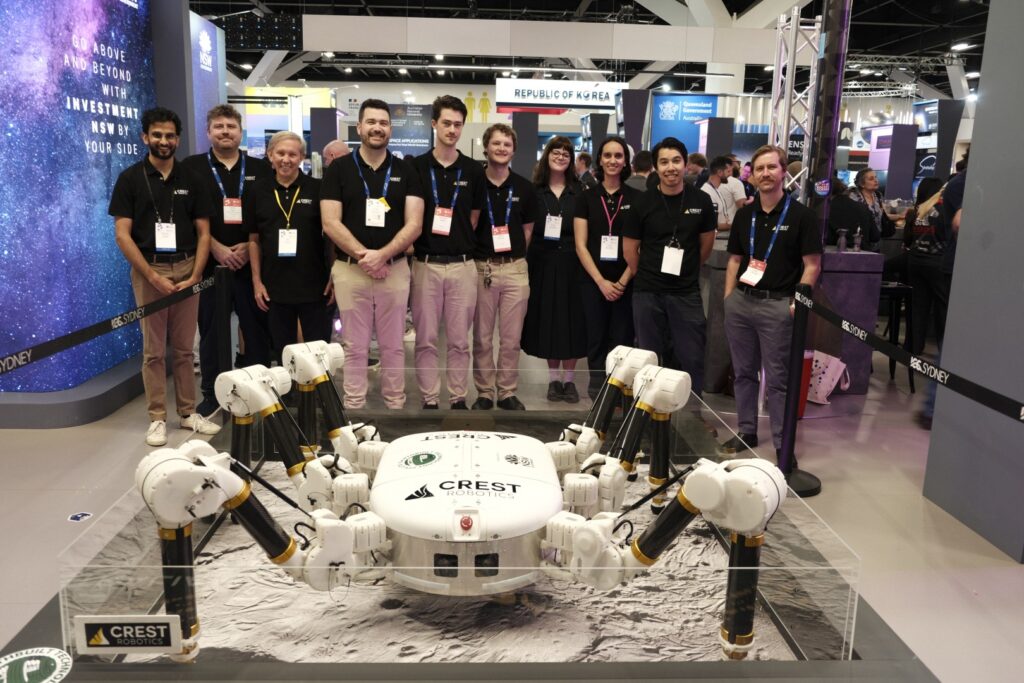
Dr. Clyde Webster is the Founder and Managing Director of Crest Robotics, a company built on a simple conviction: the industries that keep our infrastructure running and our workers safe have never needed better tools more urgently, and robotic technology has never been more capable of providing them. The gap between those two facts is the problem Crest exists to solve. As the world’s first self-proclaimed robotics morphologist, his career has been shaped by one recurring question: what form best serves a given function? His PhD at the University of Technology Sydney began with a practical challenge posed by the Tokyo Electric Power Company, on how to keep workers safe maintaining complex power transmission infrastructure. Searching for answers led him to an unlikely source of inspiration. Parrots use three limbs to navigate complex structures while performing work at height, a form perfectly matched to its function. That insight became the foundation of a novel robot architecture and a broader philosophy that has guided his work ever since. That question also took him to NASA’s Jet Propulsion Laboratory as a visiting scholar, publishing collaborative research on rover morphology for lunar exploration, and into industry as a lead engineer at Space Machines Company during Australia’s largest ever spacecraft launch. But founding his own company was always the destination, and three and a half years ago Clyde launched Crest Robotics, building it entirely from sales and competitive grants. Within the first twelve months, Crest had signed Transgrid, breaking into the energy sector ahead of any realistic expectation for a bootstrapped hardware startup. The company has since grown to a team of seven, expanding its customer base to include Powercor, Powerlink, and Zinfra. That same form-meets-function thinking shaped Charlotte, a bio-inspired construction robot that straddles walls as it prints using locally sourced materials, deployable in a fraction of the time and footprint of conventional gantry systems. Developed with support from the NSW Space+ Program, Charlotte attracted letters of collaboration from commercial lunar payload providers including Intuitive Machines and ispace when demonstrated at the 2025 International Astronautical Congress in Sydney. Clyde is actively seeking collaborations with researchers working in construction, infrastructure, and related fields, and is particularly interested in connecting with academics ready to see their work create tangible impact in industry.