
When: Thursday, 15 October, 1:00 pm AEST
Where: This seminar will be presented at the ACFR seminar area, J04, Level 2 (Rose St Building) and partially online via Zoom. RSVP
Title: PlenoCI: Plenoptic CharacterIstics for View Dependence Aware Change Classification
Speaker: Jason Lai
Abstract:
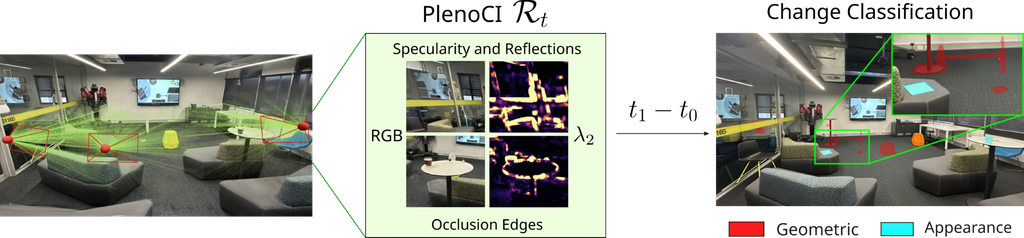
Robotic platforms working autonomously require perception algorithms robust to visually challenging environments containing occlusions and view dependence. Radiance field representations such as 3D Gaussian Splatting (3DGS) natively encode these, but they are inherently underconstrained. Given identical training views, independently optimized reconstructions converge to different primitive configurations. We introduce Plenoptic CharacterIstics (PlenoCI), a feature built from the field of light these representations approximate. PlenoCI directly captures rich visual behaviors while ignoring Lambertian textures. By deriving closed-form analytic plenoptic derivatives from a 3DGS representation, we efficiently detect these structures, while remaining robust to underconstrained representations by construction. We demonstrate PlenoCI’s utility on change classification. First, we detect changes with an instance-aware 3DGS pipeline. Then, we use PlenoCI to distinguish between geometric and appearance changes, where ignoring Lambertian textures correctly classifies texture changes as appearance-based. We believe these plenoptic tools open new directions for view dependence aware understanding in visually complex environments.
Bio:
Jason Lai is a PhD candidate at the Australian Centre for Robotics (ACFR) under the School of Aerospace, Mechanical and Mechatronic Engineering at the University of Sydney; supervised by Dr Donald Dansereau, Dr Mitch Bryson and Dr Dimilty Miller from QUT Centre for Robotics.
He received his Bachelor in Mechatronic Engineering and Science from the University of Sydney in 2023. Jason’s research interests include scene representations and computer vision techniques enabling robots to see and perceive in new ways.